
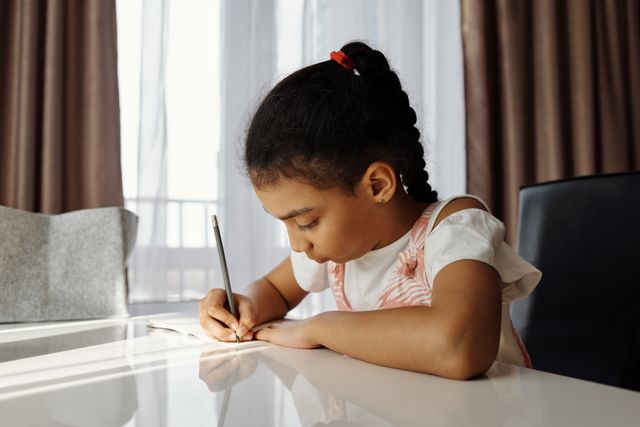
Your child can tell you an entire story about their day, explain a complicated idea, or answer questions out loud without much difficulty.
But when you ask them to write those same thoughts on paper, everything changes.
They stare at the page. Writing takes forever. Their handwriting may be difficult to read, or they become frustrated after writing just a few sentences.
You might wonder why something that seems so simple is so challenging.
For some children, writing difficulties are connected to a learning difference commonly called dysgraphia.
Understanding the signs of dysgraphia in children can help parents recognize when additional support or a comprehensive learning disability evaluation may be appropriate.
What Is Dysgraphia?
Dysgraphia is a term commonly used to describe persistent difficulties with handwriting and related writing skills.
A child experiencing these challenges may have difficulty forming letters, spacing words, spelling, or writing efficiently.
Writing involves several skills working together, including language, memory, attention, motor coordination, and the ability to organize thoughts.
When one or more of these skills is difficult, the entire writing process can become frustrating.
It’s important to understand that dysgraphia is not simply messy handwriting.
Some children have difficulty with handwriting mechanics, while others struggle more with spelling, sentence construction, or expressing ideas in writing.
These difficulties can occur separately or together.
Although dysgraphia is a commonly used term, it is not a separate diagnosis in the DSM-5-TR. Depending on the child’s difficulties and evaluation findings, a clinician may identify a specific learning disorder with impairment in written expression or another condition affecting writing.
7 Signs of Dysgraphia or Writing Difficulties in Children
Every child develops writing skills at a different pace.
However, persistent challenges that interfere with schoolwork may deserve closer attention.
1. Handwriting is consistently difficult to read
Your child’s letters may vary significantly in size, spacing, or shape.
Even when they try to write neatly, their handwriting may remain difficult to read.
Occasional messy handwriting is common, particularly in younger children. The concern is when these difficulties continue despite appropriate instruction and practice.
2. Writing assignments take much longer than expected
Your child may understand the assignment but need an unusually long time to complete it.
Writing a paragraph might take an hour, even when they can explain the information verbally in a few minutes.
This can become especially noticeable as students advance into grades requiring more written work.
3. Your child avoids writing whenever possible
Does your child suddenly need a snack, a bathroom break, or help finding a pencil whenever it’s time to write?
Avoidance isn’t always about refusing to do the work.
Sometimes children avoid activities that consistently make them feel frustrated, unsuccessful, or overwhelmed.
4. Spelling remains difficult despite practice
Your child may repeatedly misspell familiar words or spell the same word differently within one assignment.
These difficulties can sometimes occur alongside reading challenges, although a child may struggle with spelling even when reading appears relatively strong.
5. Your child has great ideas but struggles to write them down
This is one of the more confusing patterns for parents.
Your child may have an impressive vocabulary, strong reasoning abilities, and creative ideas.
But their written assignments don’t reflect those strengths.
They might produce short responses, leave out important details, or struggle to organize information into sentences and paragraphs.
6. Writing causes frustration or fatigue
Some children complain that their hands hurt after writing.
Others become upset, discouraged, or exhausted when faced with longer assignments.
Writing may require so much effort that the child has little energy left to focus on the actual content.
Hand discomfort can also reflect motor or other physical concerns that warrant additional assessment.
7. Written performance doesn’t match verbal abilities
Your child may answer questions correctly during class discussions but perform poorly on written assignments.
Teachers may notice that the student understands the material but has difficulty demonstrating that understanding through writing.
When this pattern persists, it’s worth exploring why.
Is Dysgraphia the Same as a Learning Disability?
The terms are related, but they aren’t always used in exactly the same way.
Dysgraphia is often used to describe difficulties with handwriting and the transcription skills involved in producing written language.
A specific learning disorder with impairment in written expression involves persistent difficulties with academic writing skills, such as spelling accuracy, grammar and punctuation, or the clarity and organization of written expression.
Some children experience both handwriting and written-expression difficulties.
Others may have one without the other.
This distinction matters because different writing difficulties may require different types of support.
A child struggling primarily with handwriting mechanics may benefit from an occupational therapy assessment, while a child with persistent spelling or written-composition difficulties may need specialized academic instruction.
A comprehensive evaluation can help clarify the nature of the difficulty and whether additional assessments are appropriate.
Can a Child Have Dysgraphia and ADHD?
Yes. Writing difficulties and ADHD can occur together.
Children with ADHD may experience challenges with attention, working memory, planning, or organization that affect written assignments.
For example, a child might have difficulty remembering the instructions, organizing ideas, or staying focused long enough to finish.
A child with a writing-related learning disability may experience difficulty even when attention is adequate.
Other factors, including language difficulties, motor coordination concerns, anxiety, and processing speed weaknesses, can also affect writing performance.
For some children, slow processing speed can make schoolwork take longer even when they understand the material.
Because these difficulties can overlap, it’s important not to assume that every child who struggles with writing has dysgraphia or ADHD.
How Can a Psychoeducational Evaluation Help?
A comprehensive psychoeducational evaluation can help identify a child’s academic strengths and difficulties.
Depending on the referral concerns, an evaluation may examine:
- Cognitive abilities and reasoning skills
- Academic achievement in reading, writing, and mathematics
- Spelling and written-expression skills
- Attention and executive functioning
- Working memory and processing speed
- Relevant developmental and educational history
- Emotional or behavioral factors affecting academic performance
Additional assessment of handwriting, fine motor coordination, or language skills may be recommended when appropriate.
The purpose is not simply to assign a diagnosis.
It’s to understand why the child is struggling and identify recommendations that address their individual needs.
If you’re unsure whether comprehensive testing is appropriate, learning more about when a child may need a psychoeducational evaluation can be a helpful starting point.
What Can Parents Do to Support a Child Who Struggles With Writing?
There are several ways parents can begin supporting their child’s writing development.
Let your child explain ideas out loud first
Sometimes talking through an assignment helps children organize their thoughts before writing.
You might ask your child to explain what they want to say and then help them create a simple outline.
Break assignments into smaller steps
Instead of asking your child to write an entire paragraph at once, begin with one sentence or one idea.
Smaller steps can make the task feel more manageable.
Consider appropriate writing tools
Typing, speech-to-text software, graphic organizers, or other tools may help some children demonstrate their knowledge.
These supports should be selected based on the child’s needs and should complement, rather than automatically replace, appropriate writing instruction.
Focus on one skill at a time
Correcting handwriting, spelling, punctuation, grammar, and content all at once can be overwhelming.
Depending on the assignment, it may be more helpful to focus on the child’s ideas first and address other writing skills separately.
Communicate with your child’s teacher
Ask whether similar writing difficulties are occurring in the classroom.
Understanding when the difficulties appear can help determine which supports or assessments may be useful.
Recognize your child’s effort
Writing may require considerably more effort for some children.
Acknowledging persistence and improvement can help support confidence while they develop new skills.
Can Dysgraphia Qualify a Child for School Accommodations?
Depending on the child’s documented needs and eligibility, schools may consider supports such as:
- Additional time for written assignments
- Access to typing or assistive technology
- Reduced copying demands
- Graphic organizers
- Alternative ways to demonstrate knowledge
- Specialized instruction in writing skills
However, a diagnosis or writing difficulty does not automatically qualify a student for an Individualized Education Program (IEP) or Section 504 plan.
Schools determine eligibility and appropriate services based on applicable criteria and the student’s educational needs.
A comprehensive evaluation may provide useful information to support these discussions.
When Should Parents Consider a Learning Disability Evaluation?
Consider seeking additional information when your child’s writing difficulties:
- Persist despite appropriate instruction and support
- Significantly interfere with school assignments
- Cause ongoing frustration or avoidance
- Appear inconsistent with their verbal or reasoning abilities
- Affect academic performance or confidence
- Raise questions about ADHD or another learning difficulty
You don’t have to wait until your child is failing classes to begin asking questions.
Understanding the difficulty earlier may help you identify appropriate support before frustration becomes an even bigger part of your child’s school experience.
Understanding Your Child Beyond Their Handwriting
A child’s writing abilities don’t tell the whole story of their intelligence, creativity, or potential.
Some children have wonderful ideas but struggle with the mechanics or organization of putting those ideas on paper.
When parents understand what’s contributing to those difficulties, they can respond with more appropriate support rather than assuming the child simply needs to try harder.
At Hammond Psychology & Associates, we provide comprehensive learning disability evaluations and psychoeducational testing for children and adolescents in Brandon and the greater Tampa Bay area.
Our evaluations are designed to identify learning strengths, clarify academic difficulties, and provide individualized recommendations.
If your child is struggling with writing, spelling, or other academic skills, contact our office to discuss whether an evaluation may be appropriate.
Call (813) 654-0503 or visit hammondpsychology.com.
This article is intended for educational purposes and does not replace an individualized psychological, medical, or educational evaluation.